
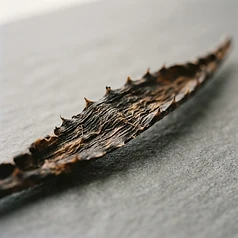
Aloe Vera Leaf
Herb · powder · Sonora, Mexico
If Aloe ferox is the wild, bitter aloe of the African rock paintings, Aloe vera is its opposite in nearly every way — starting with its name. Vera is Latin for "true" or "genuine," a title given to distinguish it from the many other aloe species already known to the ancient world.
Aloe vera's documented history may be the oldest of any plant in this collection. Sumerian clay tablets from around 2100 BC already describe its laxative properties, and by the time of ancient Egypt it had earned the title "the plant of immortality." The Ebers Papyrus, a 1,550 BC Egyptian medical text, details its healing uses, and Egyptian tradition holds that both Nefertiti and Cleopatra relied on aloe as part of their beauty regimens. Pharaohs were even given aloe as a funerary offering, believed to help preserve the body for the afterlife.
Its most remarkable chapter, though, may be military. According to ancient accounts, Aristotle convinced his student Alexander the Great to conquer Socotra, a remote island off the coast of present-day Yemen, specifically to secure control of its aloe groves — reportedly stocking his supply wagons with potted plants so wounded soldiers could be treated on campaign. After the conquest, Alexander is said to have installed Greek gardeners on the island to cultivate it. Some historians even suspect that the Aloe vera we know today first emerged there, as a cultivated hybrid bred by those very gardeners — meaning the "true aloe" may never have existed in the wild at all, only as something people made on purpose.
That same reputation for preserving and prolonging life carried directly into European alchemy centuries later. Aloe was a genuine ingredient in elixirs historically associated with Paracelsus himself, including formulas known as "Paracelsus Elixir" and Élixir de Longue Vie, the Elixir of Long Life — placing aloe vera squarely within alchemy's central pursuit: a substance capable of holding off death itself.
Whatever its exact origin, Aloe vera went on to become one of the most widely cultivated plants on Earth, its clear inner gel now a fixture of skincare, burn treatment, and health products worldwide — a very different fate from Aloe ferox's rarer, still wild-harvested bitter sap.