
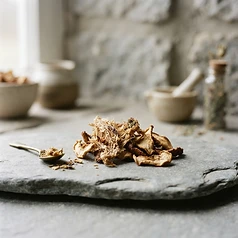
Apple Cider Vinegar
Herb · powder
Vinegar is one of humanity's oldest kitchen discoveries, likely stumbled upon by accident when wine or cider was left exposed to air and fermented a second time. Traces of it have been found in Egyptian and Chinese vessels more than 6,000 years old, and Babylonian records describe using it as a preservative as far back as 5000 BC.
The Romans built it into daily military life: soldiers drank posca, a mix of vinegar and water, both to stay hydrated on long campaigns and to make questionable water safer to drink. Around 400 BC, the Greek physician Hippocrates — still remembered as the father of medicine — was recommending vinegar to clean wounds and prescribing oxymel, a blend of vinegar and honey, for coughs and colds. That same vinegar-and-honey combination would resurface, almost unchanged, more than two thousand years later.
For centuries, no one understood why fermentation actually worked — it wasn't until 1822 that Dutch scientist Christian Persoon identified the bacteria responsible for turning fermented juice into vinegar, a discovery Louis Pasteur later confirmed and expanded on.
Long before that scientific understanding arrived, though, vinegar already had a serious working life in alchemy — not as a symbol, but as an actual laboratory reagent. Alchemists used it to dissolve metals and produce pigments like white lead and verdigris, a practice documented as far back as Theophrastus in the third century BC, and to help extract mercury from cinnabar ore. Vinegar was significant enough to earn its own dedicated alchemical symbol (🜊), representing acetum — proof that its role went well beyond the kitchen.
Apple cider vinegar's modern popularity in America, though, traces back to one specific book. In 1958, a rural Vermont physician named D.C. Jarvis published Folk Medicine: A Vermont Doctor's Guide to Good Health, drawing on decades of local folk remedies he'd studied throughout his career. His recommendation of daily apple cider vinegar and honey — a tonic he called "honegar" — became a bestseller and is largely responsible for apple cider vinegar's enduring place in American kitchens and medicine cabinets today, more than sixty years later.