
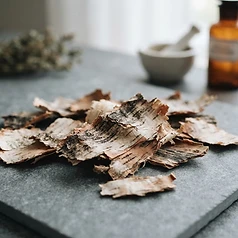
Birch Bark
Herb · c/s · Siberia, Russia
Birch bark tar might be the oldest manufactured substance in human history — and "human" might not even be the right word, since the earliest evidence for it predates our own species' presence in Europe entirely.
Birch tar is made by heating birch bark without oxygen, a process called dry or anaerobic distillation, carried out at a fairly precise 340–400°C. That's not something you stumble into by accident, which is part of what makes the discovery of who was doing it so remarkable: archaeological finds in Italy and Germany show Neanderthals producing and using birch tar as an adhesive as far back as roughly 200,000 years ago, hafting stone blades onto wooden handles and spears. It stands as the world's oldest known synthetic material, and its production implies a level of controlled, deliberate technological skill that has reshaped how scientists think about Neanderthal capability. Thousands of years later, the famous Alpine mummy known as Ötzi was still using the same substance to fix his arrowheads to their shafts.
One of the strangest chapters in birch tar's history belongs to the people who chewed it. Archaeologists have long found ancient wads of hardened birch pitch bearing clear human tooth marks — evidence people chewed the tar, likely to soften it before use, though the full reason remains uncertain. What makes this remarkable today is that the chewed tar preserved something no one at the time could have anticipated: human DNA. Researchers have successfully extracted and sequenced genetic material directly from these ancient chewing wads, including samples from a Mesolithic site in Sweden dated to roughly 9,500–9,900 years old, allowing scientists to reconstruct the genetic ancestry of specific individuals who lived millennia before any written record — all because they'd once chewed a piece of birch bark and, without knowing it, left themselves behind in it.
Birch bark's more recent history is quieter but still notable: sweet birch, the species most associated with its use in herbal medicine, was once harvested so heavily for its natural oil of wintergreen that the tree edged close to endangered status. It wasn't until synthetic wintergreen oil became available in the 1950s and 60s that the pressure on wild sweet birch finally eased.