
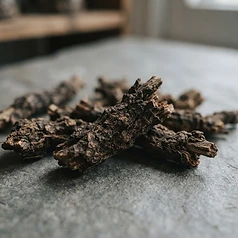
Black Cohosh Root
Herb · c/s · Appalachia, United States
Black cohosh's name undersells it a little: "cohosh" comes from an Algonquian word simply meaning "rough," a plain reference to the knobby texture of its root. Its older botanical name, Cimicifuga, tells a different story — from the Latin for "bug" and "to drive away," a nod to the plant's old reputation, along with several close relatives, as a natural bedbug repellent, which is also where nicknames like bugbane and bugwort come from. Coincidentally, the Iroquois name for the plant is said to translate to "smells like a horse" — the exact same folk etymology attached, half a world away, to ashwagandha.
Its real legacy, though, is in women's health. Algonquian peoples of the Ohio Valley, along with the Cherokee, Iroquois, and Delaware, used black cohosh root for centuries to ease menstrual complaints and labor, alongside broader uses for rheumatism, sore throat, fatigue, and snakebite. European colonists adopted the plant directly from Native American practice, and by the 1820s it had earned a place in the official U.S. Pharmacopoeia. In the 19th century it became a signature herb of the Eclectic medical movement, an alternative American medical tradition built around botanical remedies, where physicians like Dr. John King promoted it under the name Macrotys.
Black cohosh's biggest commercial moment came through Lydia E. Pinkham, a Massachusetts folk healer whose Vegetable Compound, launched in 1875, became one of the most successful patent medicines in American history and reportedly the foundation of the first major American business run by a woman. Pinkham's own handwritten recipe lists black cohosh alongside fenugreek, unicorn root, life root, and pleurisy root — a genuine blend of women's herbal tradition. The company built an empire on aggressive, deeply personal marketing, encouraging women to write to Pinkham directly and answering with persuasive replies that, tellingly, kept arriving years after she had died.
That popularity has a modern consequence worth knowing: black cohosh is almost entirely wild-harvested rather than farmed, and since it's the root that's used, harvesting means digging up the whole plant. Demand grew so sharply in the late 1990s that a formal proposal was made in 2002 to list black cohosh under CITES Appendix II for international trade protection. The proposal was ultimately rejected, so it carries no current trade restriction, but it remains flagged as at-risk by conservation groups, and is already listed as endangered in a couple of individual states — a real pressure point behind a plant with a much lighter reputation than its history actually earns it.