
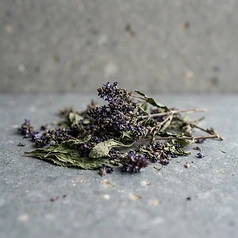
Blue Vervain Herb
Herb · c/s · Midwest, United States
Blue vervain's name carries an old promise it doesn't entirely keep alone. Verbena was the Latin word for the sacred leafy branches laid on altars in ancient ceremony, and the genus carries that reputation largely because of blue vervain's Old World cousin, European vervain (Verbena officinalis) — a plant Roman priests believed sprang from the tears of the goddess Juno, used to sweep temple altars, and which medieval Europeans hung in homes as protection against plague, evil spirits, and storms. Blue vervain, the species native to North America, is often mistaken for its famous relative, but it built its own, entirely separate reputation on this continent long before the two plants' stories ever crossed paths.
That reputation runs deep. Both the Dakota and the Omaha-Ponca gave this plant a name that simply translates to "medicine," a description of how central it was to their healing traditions. It was used as a spring tonic to strengthen the liver, kidneys, and lungs, and taken for fevers, headaches, insomnia, and low spirits. The Cherokee turned to its leaves, seeds, and roots for colds and coughs, its dried and powdered flowers were sniffed to stop nosebleeds, and it was specifically used as an antidote to pokeweed poisoning. Its most memorable documented use, though, belongs to the Iroquois, who prepared a cold infusion of the mashed leaves for a very particular purpose: a protective medicine meant, in their own words, to make obnoxious people go away.
Blue vervain's reputation carried directly into 19th-century American medicine. An 1854 medical journal article specifically documented physicians using it for fevers and jaundice tied to liver trouble, and the Eclectic medical movement — the same herbal tradition that championed black cohosh — later adopted it as a remedy for frayed nerves. That calming, nervine reputation is exactly what modern herbalists still reach for blue vervain to provide today.