
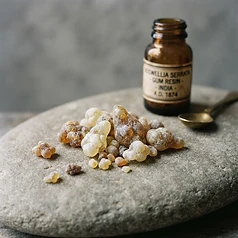
Boswellia Serrata
Herb · pieces · Rajasthan, India
Boswellia serrata is India's own frankincense tree — a distinct species from the Arabian and East African trees (Boswellia sacra and its relatives) most associated with the frankincense of the biblical Magi and ancient Egyptian temple rites. Boswellia serrata built its own, equally ancient reputation, entirely independent of that more famous trade route, rooted specifically in the classical medical tradition of India.
Known in Sanskrit as Shallaki and in Hindi as Salai Guggul, its resin has been documented in Ayurvedic medicine for more than 3,000 years, appearing in the foundational texts of the tradition, the Charaka Samhita and Sushruta Samhita — the same classical texts that first recorded ashwagandha's use. Ayurvedic physicians classified Shallaki within the Tridosha system as a balancer of Vata and Kapha, and prized it as a Rasayana, the same category of rejuvenating, long-term tonic herbs that included astragalus in Chinese medicine and ashwagandha in India's own tradition.
Boswellia serrata's resin is harvested the same way frankincense has always been gathered: by cutting the bark and letting the exuded sap harden into aromatic tears, prized for centuries both as incense and as medicine, particularly for joint and inflammatory complaints. Modern research has isolated the specific compounds responsible, a family of molecules called boswellic acids, confirming much of what Ayurvedic physicians had already concluded through simple, sustained observation.
One name worth keeping separate: Shallaki is sometimes confused with guggul, another resin used in Ayurveda, but guggul comes from an entirely different tree, Commiphora mukul — a different plant, a different resin, sharing only a broad category of use.
This is also one of the more urgent conservation stories in this collection. Boswellia serrata is not currently listed under CITES, but the entire Boswellia genus is under active review by the CITES Secretariat due to documented overharvesting across multiple species. In India specifically, B. serrata has been assessed as rare with a high extinction risk, showing low fruit set from overexploitation — one regional study projects local extinction within 15 years in parts of its range, with an overall population decline of up to 90% over the next 50.