
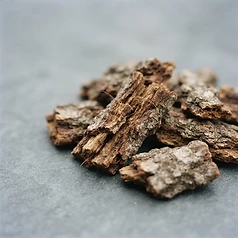
Cat's Claw Bark
Herb · c/s · Amazon Rainforest, Peru
Cat's claw takes its name plainly from its appearance: the small, curved thorns that let this Amazonian vine hook and climb its way up into the rainforest canopy, sometimes reaching over 100 feet tall, look remarkably like a cat's claws. In Spanish, it's known simply as uña de gato.
Its use among Amazonian peoples, especially Peru's Ashaninka community, stretches back an estimated 2,000 years, and it was treated with a reverence beyond an everyday remedy — some accounts describe its use as restricted specifically to priests within certain traditions, a sacred healing plant rather than a casual household herb. Across the many indigenous groups of the Amazon and Central America, cat's claw bark was brewed into decoctions for an extraordinarily wide range of complaints: inflammation, rheumatism, gastric ulcers, fevers, tumors, and diabetes among them, and in large doses it was also reportedly used as a contraceptive by several tribes. In Peru today, it still shows up in emoliente, a traditional hot drink blending cat's claw with toasted barley, flaxseed, and horsetail as a digestive tonic.
Cat's claw's path into Western science began earlier than most people assume. In the early 1970s, an Austrian journalist and self-taught ethnologist named Klaus Keplinger began studying the plant in Peru, eventually organizing the first serious scientific investigation into its chemistry. That early work grew into real pharmacological research: Keplinger went on to co-author peer-reviewed studies on the plant's alkaloids and even held a U.S. patent on extracting its active compounds for immune-system applications. His research laid the groundwork for cat's claw's much larger arrival in Western herbal medicine in the early 1990s, when it became a prominent adjunctive supplement explored alongside cancer and AIDS treatment.
A couple of naming notes worth knowing: two related vines are sold under the same "cat's claw" name, Uncaria tomentosa and Uncaria guianensis, both used similarly by Amazonian peoples, though tomentosa is the species more common in Western herbal medicine. Confusingly, several entirely unrelated plants in Mexico and other parts of Latin America are also called "cat's claw" locally, despite belonging to different plant families entirely.
One practical note on sourcing: cat's claw is still mostly wild-harvested rather than cultivated, and its stems don't become mature enough to harvest until the vine is at least 8 years old. Sustainable practice calls for cutting the vine well above the root and leaving it to regenerate, rather than removing it outright.