
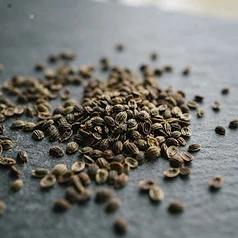
Celery Seed
Spice · whole · Punjab, India
Celery seed's ancient reputation had almost nothing to do with the dinner table, and almost everything to do with death.
In ancient Greece, celery — wild celery specifically, since the crisp, mild stalk vegetable wasn't developed until the Middle Ages — was so closely associated with mourning that the phrase deisthai selinon, "to need celery," was simply Greek slang for being near death. Wreaths of it were laid on graves, a practice the writer Plutarch specifically documented as commonplace. That association traces back to a specific, tragic myth: the Nemean Games, one of the four great Panhellenic athletic festivals alongside the Olympics, were said to have been founded in memory of an infant named Opheltes, who died of a snakebite while his nurse briefly stepped away to show a group of legendary heroes where to find water. In his honor, the games' judges wore black robes of mourning, and victors were crowned not with the olive wreaths of Olympia, but with wreaths of wild celery. At the neighboring Isthmian Games, celery crowned champions too, at least in the poet Pindar's era, before later being replaced with pine. (The Pythian Games, held in that same four-year Panhellenic cycle, crowned their winners with laurel instead — a separate, equally famous sacred-plant tradition of its own.)
Celery's reach went back even further than Greece. Wild celery leaves were woven into the funerary garlands found in King Tutankhamun's tomb, and the plant appears by name — as selinon — in Homer's Odyssey, growing wild outside the cave of the nymph Calypso.
By the 17th century, the English herbalist Nicholas Culpeper was still recommending "smallage," wild celery's common name, for its cleansing and diuretic properties in his 1653 Complete Herbal — carrying the same plant, seed and all, from ancient funeral wreaths into early modern medicine, long before anyone thought to eat its stalk.