
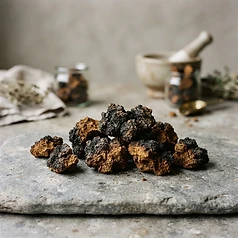
Chaga Mushroom
Herb · powder · Siberia, Russia
Chaga's origin story begins with a myth about a scab. The Cree people of North America tell of a mythological figure who threw a piece of dried scab against a birch tree, mistaking it for meat — and where it struck, the first chaga grew. The Cree later burned dried chaga in ceremonial pipes for its naturally sweet-smelling smoke, while other nations found their own specific uses: the Gitksan burned a sliver of the fungus for joint pain, and the Dena'ina of south-central Alaska used it to relieve toothaches.
Across the Bering Strait, chaga became a genuine staple of Siberian life. The Khanty people of western Siberia are among its earliest documented users, brewing the fungus into a daily tea credited with easing gastric complaints and boosting resilience through brutal winters. That everyday habit had a notable side effect: too poor to afford real tea, generations of Russian peasants drank chaga instead — a substitution Finland would later repeat out of wartime necessity, using chaga as a coffee substitute during the Second World War.
Chaga's leap into Western awareness came from an unlikely source: a novel. In 1968, the Nobel laureate Aleksandr Solzhenitsyn published Cancer Ward, drawing partly on his own recovery from cancer. In a chapter titled "The Cancer in the Birch Tree," he describes a village doctor who noticed something unusual: none of the peasants he treated, all of whom drank chaga tea instead of real tea they couldn't afford, ever seemed to develop cancer. The observation captured readers' imaginations far beyond Russia — though it's worth noting chaga had already received a more official kind of recognition over a decade earlier, when the Soviet Medical Academy of Science formally approved a chaga-derived extract called Befungin as a medicinal preparation in 1955.
Botanically, chaga occupies an odd place of its own: what's harvested and sold isn't really a mushroom in the usual sense, but a hardened, sterile mass the fungus builds on the outside of a living birch tree, long before it ever reproduces. That biology is exactly what makes chaga's modern popularity a genuine concern among mycologists. The fungus only releases spores from a true fruiting body during a narrow one- to two-day window after its host tree finally dies — a stage rarely seen and easily disrupted. Harvesting the conk before that point, which is how virtually all commercial chaga is collected, can remove a colony before it ever gets the chance to reproduce at all. Chaga cannot currently be commercially cultivated, and Alaska has responded by capping public-land harvests at 10,000 pounds per person per year — a real, active regulatory response to a problem that's tied directly to how the organism itself is built.