
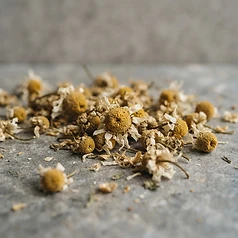
Chamomile
Herb · whole · Cairo, Egypt
Few herbs carry as unbroken a thread of reputation across so many civilizations as chamomile. Ancient Egyptians considered it sacred above nearly every other plant, dedicating it to Ra, the sun god, and using it both in embalming, to help repel insects, and in cosmetics favored by Egyptian noblewomen. Its very name preserves that ancient reverence for its scent: chamomile comes from the Greek khamai ("on the ground") and melon ("apple"), a nod to its low-growing habit and the apple-like fragrance released when its flowers are crushed. That same etymology traveled into Spanish as manzanilla, "little apple" — which is exactly where Manzanilla sherry gets its name, since the wine's aroma is said to echo chamomile's own. The plant's other common genus name, Matricaria, comes from an entirely different root, the Latin matrix, or "womb," reflecting its long traditional use in women's health.
In Anglo-Saxon England, chamomile — known then as maythe — was one of nine sacred plants named in the Nine Herbs Charm, a healing incantation recorded in the tenth-century Lacnunga manuscript and invoked to protect against disease and poison. Romans, meanwhile, scattered the flowers at banquets to perfume the air and burned them as incense in religious rites, while Greek physicians like Dioscorides prescribed it for fevers centuries before the Common Era.
Medieval Europeans put chamomile to work in more practical ways too: strewn across floors and burned as incense to mask foul smells and ward off infection, and even grown as a fragrant, low-growing lawn substitute in gardens long before turf grass became the standard. Shakespeare himself used the plant as a metaphor in Henry IV, observing that chamomile seems to thrive precisely because it's stepped on, growing all the faster for the wear.
Today, two different plants are sold interchangeably as "chamomile" — German chamomile and Roman, or English, chamomile — a distinction most people never notice, since both carry forward the same gentle, apple-scented reputation that's followed this flower for roughly five thousand years, from sacred offerings to sun gods to the simple cup of tea still reached for at bedtime.