
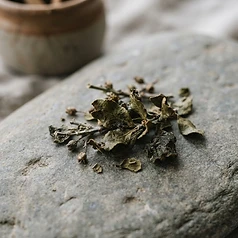
Chaparral Leaf
Herb · c/s · Sonoran Desert, USA
Chaparral may be home to the single oldest living thing most people have never heard of.
In California's Mojave Desert grows a ring of creosote bush known as King Clone, estimated to be roughly 11,700 years old — a single clonal organism that was already ancient before the pyramids, before writing, before agriculture existed anywhere on Earth. It isn't one continuous plant in the usual sense; its original center died long ago, and the ring has simply kept expanding outward from its edges for thousands of years since, each new stem a genetic clone of the last. Growth is so slow that when the naturalist David Attenborough filmed the same bush for a documentary in 1982 and returned to film it again roughly forty years later, it had grown less than a single inch.
The plant itself is a relatively recent arrival to North America in geological terms, having crossed over from South America, where its closest relatives still grow, somewhere between 16,000 and 18,000 years ago as the last ice age retreated. Its more common name, creosote bush, comes from its sharp, tar-like scent — especially noticeable after rain, and often cited as the true source of the distinctive "smell of rain" across the desert Southwest. "Chaparral" is specifically the name the plant carries when used medicinally, distinguishing its herbal history from its identity as a wild desert shrub.
That medicinal history runs deep, with more than fifty documented traditional uses. The Tohono O'odham, who call the plant ṣegoi, used its leaves in steam baths and poultices for arthritis and rheumatism — a use modern research has partly validated, since a compound in the plant's resin called NDGA has shown genuine anti-inflammatory activity in laboratory studies. Various desert peoples relied on it more broadly for colds, digestive complaints, skin conditions, and toothaches, and the Cahuilla incorporated it into rituals of spiritual purification and protection.
That long traditional history, though, comes with a real and serious modern caution. Chaparral was removed from the FDA's "generally recognized as safe" list as early as 1968 after animal studies raised concerns, and by 1992, following multiple documented cases of acute liver damage in chaparral users — some severe enough to require emergency liver transplants — the FDA's commissioner issued a direct public statement that the public should not purchase or consume chaparral. Health Canada issued a similar warning in 2006. The exact mechanism behind these cases remains somewhat debated among researchers, but the official guidance on ingestion has been consistent and unambiguous for decades.
This product is sold for historical, educational, and craft purposes only. It is not intended for consumption.